Six Encounters with Lincoln by Elizabeth Brown Pryor
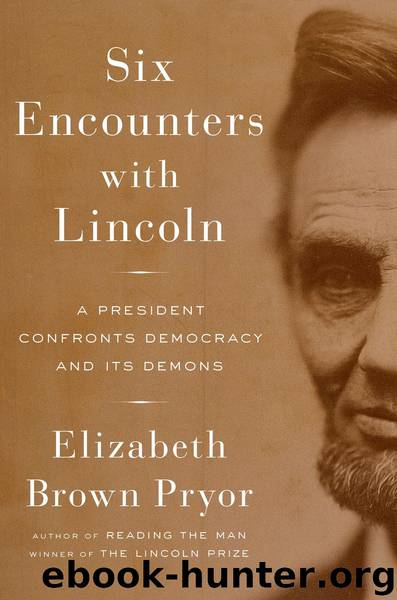
Author:Elizabeth Brown Pryor
Language: eng
Format: epub
Publisher: Penguin Publishing Group
Published: 2017-02-10T09:49:06+00:00
“President Lincoln riding through Richmond, April 4, amid the enthusiastic cheers of the inhabitants,” wood engraving,
Frank Leslie’s Illustrated Newspaper, April 22, 1865
“President Lincoln visiting the late residence of Jefferson Davis in Richmond, April 4,” wood engraving,
Frank Leslie’s Illustrated Newspaper, April 29, 1865
Shepley and other officers escorted Lincoln to their headquarters in the White House of the Confederacy, Jefferson Davis’s former seat of power. An exhausted Lincoln sank into a chair—Davis’s old desk chair, according to some—and consulted with the generals. A few prominent men who had not fled arrived to sound out the President on his plans for peace. Some witnesses reported that Lincoln wrote dispatches, toasted Union success with a sherry flip, and wandered over the house with boyish curiosity and glee. Others stated he addressed a crowd of former slaves in front of the mansion, telling them they were as free as he, and “had no master now but God.” Exactly what transpired is not clear, but certainly Lincoln, who had been through a week of extreme tension, was awed by the magnitude of what he was witnessing, and emotionally worn out. Around 4:35 p.m. the Malvern arrived at Richmond’s wharves and fired a thirty-five-gun salute, signaling to the citizenry that they had an extraordinary visitor. Lincoln and Porter then climbed into a small, two-seated military wagon, drawn by four horses, with Tad on his father’s lap, and a clattering horse guard following. Moving briskly, they toured what was left of the once noble heart of the Confederacy, passing Thomas Crawford’s heroic statue of George Washington, the elegant Capitol designed by Thomas Jefferson, the ghostly burnt mansions, the old slave auction rooms, and notorious Libby Prison. All the while, they were surrounded by a weeping, cheering, exultant African American crowd. At one point the President’s party hastily retreated from an encounter with the sorry-looking funeral cortege of Confederate general A. P. Hill, who had been killed two days earlier near Petersburg. Sometime around 6:30 p.m. the entourage reached the wharf and boarded the Malvern, for the return trip to the Union base at the village of City Point.15
It had been a memorable, raucous, and risky day. What lingered was the image of those ecstatic freedmen and -women, so grateful for their liberation, and so hopeful of better prospects. A few working-class whites had joined the procession—what one stylish matron called “the low, lower, lowest of creation”—but for the most part the white population had remained purposefully absent from the scene. Many found the display of black enthusiasm distasteful or frightening. “I wish you could have witnessed Lincoln’s triumphal entry into Richmond,” sniffed Mary Custis Lee, who still believed her husband would be victorious. “He was surrounded by a crowd of blacks whooping & cheering like so many demons there was not a single respectable person to be seen.” Some Richmonders were too overcome to enter the streets and “kept themselves away from a scene so painful,” or they were too angry to acknowledge Lincoln with their presence. One
Download
This site does not store any files on its server. We only index and link to content provided by other sites. Please contact the content providers to delete copyright contents if any and email us, we'll remove relevant links or contents immediately.
Fanny Burney by Claire Harman(26592)
Empire of the Sikhs by Patwant Singh(23069)
Out of India by Michael Foss(16845)
Leonardo da Vinci by Walter Isaacson(13310)
Small Great Things by Jodi Picoult(7113)
The Six Wives Of Henry VIII (WOMEN IN HISTORY) by Fraser Antonia(5495)
The Wind in My Hair by Masih Alinejad(5085)
A Higher Loyalty: Truth, Lies, and Leadership by James Comey(4947)
The Crown by Robert Lacey(4802)
The Lonely City by Olivia Laing(4796)
Millionaire: The Philanderer, Gambler, and Duelist Who Invented Modern Finance by Janet Gleeson(4461)
The Iron Duke by The Iron Duke(4348)
Papillon (English) by Henri Charrière(4255)
Sticky Fingers by Joe Hagan(4188)
Joan of Arc by Mary Gordon(4098)
Alive: The Story of the Andes Survivors by Piers Paul Read(4017)
Stalin by Stephen Kotkin(3956)
Aleister Crowley: The Biography by Tobias Churton(3628)
Ants Among Elephants by Sujatha Gidla(3459)
